Showing posts with label chesnut mary. Show all posts

Thursday, November 24, 2011

Appearances

This entry is from Mary Chesnut's Civil War, edited by C. Vann Woodward. Mary Chesnut was married to James Chesnut, United States Senator from South Carolina, 1859-1861, and afterward an Aide to Jefferson Davis, and a Brigadier General in the Confederate Army.   The sentiments she describes in her diary entry for November 24 were probably shared by many.


November 24, 1861


Hymn at Church:


Save us Lord, or we perish
When through the torn sail the wild tempest is howling
When o'er the dark wave the dread lightning is gleaming*


I could have rested my head on that cushion and sobbed and shrieked like a new convert at a revival camp meeting.  But not an eyelash moved. So much for civilized self-control.

*Lines slightly misquoted from a hymn by Reginald Heber appearing in Hymns Written and Adapted to the Weekly Service of the Year (1827)
Mary Chesnut

Friday, October 14, 2011

My Country, May She Be Right

This entry is from Mary Chesnut's Civil War, edited by C. Vann Woodward. Mary Chesnut was married to James Chesnut, United States Senator from South Carolina, 1859-1861, and afterward an Aide to Jefferson Davis, and a Brigadier General in the Confederate Army.

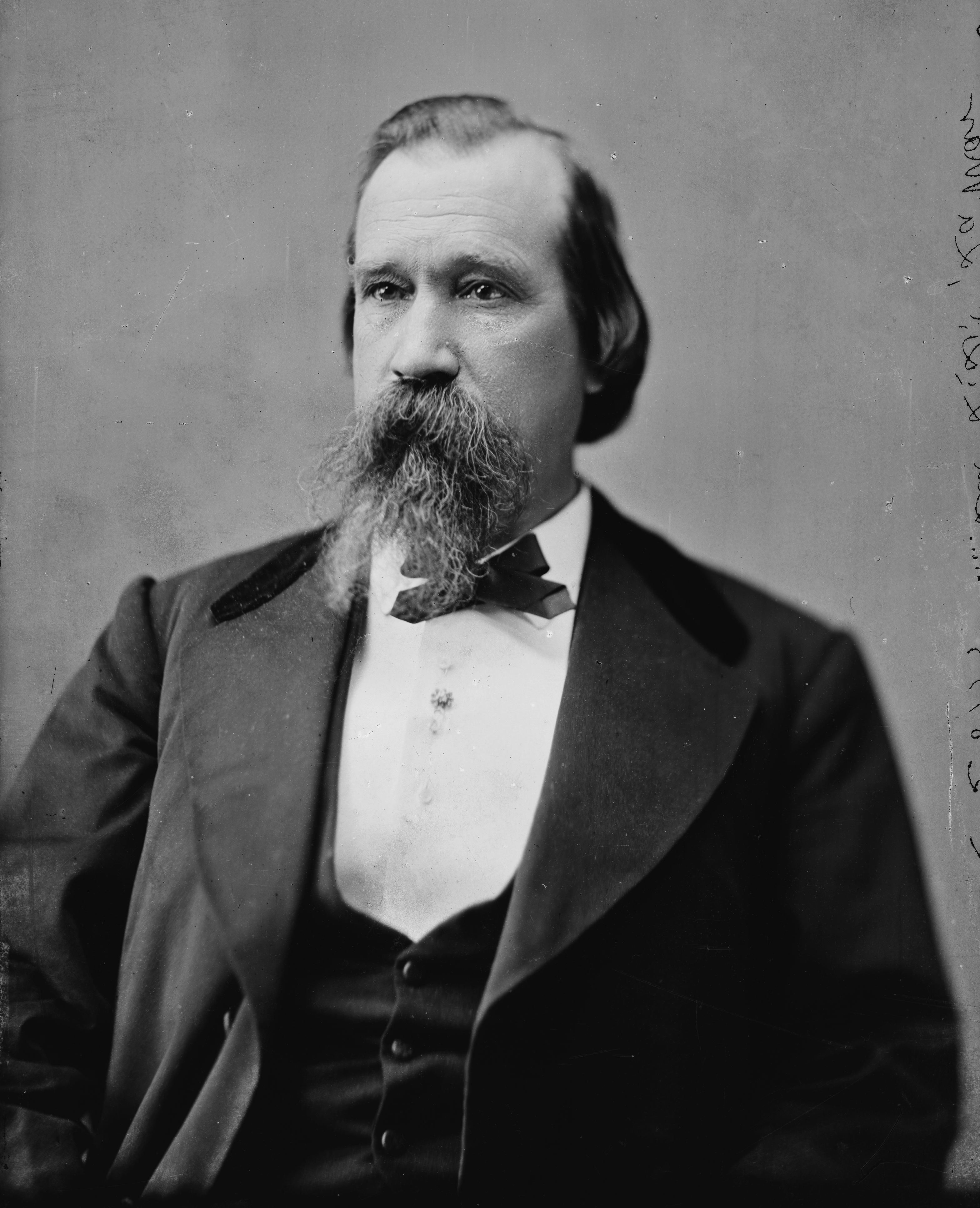
Lucius Quintus Cincinatus Lamar II, who Chesnut speaks of in this quote was a politician and was involved in raising and funding the 19th Mississippi Volunteer Infantry of which he became Lieutenant Colonel.


Lamar (L.Q.C., and the cleverest man I know) said to me in Richmond, in one of those long talks of ours, "Slavery is too heavy a load for us to carry."  We agreed to take up David Crockett's slogan, "My country, may she be right -- but my country, right or wrong."

Lucius Quintus Cincinatus Lamar II, photograph by Matthew Brady from Library of Congress collection.


Wednesday, September 21, 2011

Cousin Betsey Witherspoon

This entry is from Mary Chesnut's Civil War, edited by C. Vann Woodward. Mary Chesnut  was married to James Chesnut, United States Senator from South Carolina, 1859-1861, and afterward an Aide to Jefferson Davis, and a Brigadier General in the Confederate Army.

A cousin of Mary Chesnut's,  Betsey Witherspoon, had recently been murdered by her slaves.
From entries dated September 21 and 24, 1861:

Last night when the mail came in, I was seated near the lamp.  Mr. Chesnut, lying on a sufa at a little distance, called out to me, "Look at my letters and tell me about them."

I began to read one aloud; it was from May Witherspoon -- and a brok down.  Horror and amazement was too much for me.  Poor Cousin Betsey Witherspoon was murdered!  She did not die peacefully, as we supposed, in her bed. Nurdered by her own people.  Her negroes. . . .
Her household negroes were so insolent, so pampered and insubordinate, that she lived alone and at home.  She knew, she said, that none of her children would have the patience she had with these people who had been indulged and spoiled by her until they were like spoiled children.  Simply intolerable. . . .


. . . .Hitherto I have never thought of being afraid of negroes.  I had never injured any of them.  Why should they want to hurt me?  Two-thirds of my religion consists of trying to be good to negroes because they are so in my power, and it would be so easy to be the other thing.  Somehow today I feel that the found is cut away from under my feet.  Why should they treat me any better than they have done Cousin Betsey Witherspoon?
 Sweet potato planting, Hopkinson's Plantation, from Library of Congress Collection

Thursday, August 18, 2011

A Spy Drinking Tea

This entry is from Mary Chesnut's Civil War, edited by C. Vann Woodward. Mary Chesnut  was married to James Chesnut, United States Senator from South Carolina, 1859-1861, and afterward an Aide to Jefferson Davis, and a Brigadier General in the Confederate Army.
From an entry dated August 18, 1861:
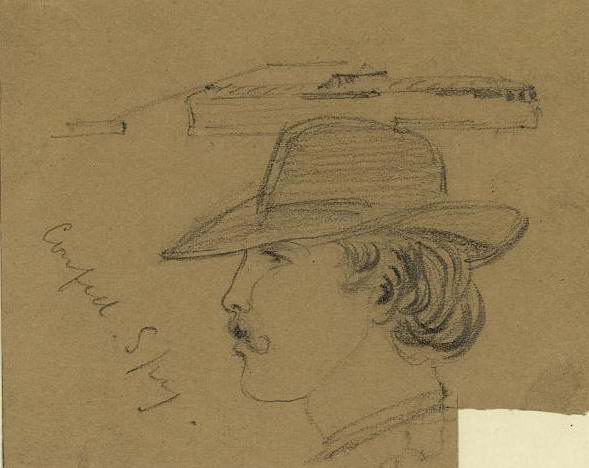
Found it quite excting to have a spy drinking his tea with us.  Perhaps because I knew his profession, I did not like his face.  He is said to have a scheme by which Washington will fall into our hands like an overripe peach.

The tea drinker was identified in the 1860s Journal as George Donellan, a member of the Confederate spy ring in Washington that had sent information on Union troop movements to Beauregard before Bull Run.  Apparently his "scheme" never came to "fruition."

Head of a Confederate Spy, from Library of Congress Collection

Saturday, July 16, 2011

A Gentleman's Gentleman

This entry is from Mary Chesnut's Civil War, edited by C. Vann Woodward. Mary Chesnut  was married to James Chesnut, United States Senator from South Carolina, 1859-1861, and afterward an Aide to Jefferson Davis, and a Brigadier General in the Confederate Army.
From an entry dated July 16, 1861:
When he comes up here he rarely brings his body servant, a negro man.  Laurence has charge of all of Mr. Chesnut's things, -- watch, clothes, two or three hundred gold pieces lie in the tray of his trunk.  All these papers &cc he tells Laurence to bring to me if anything happens to him.  But I said, "Maybe he will pack off to Yankees --and freedom -- with all that."
"Fiddlesticks! He is not going to leave me for anybody else.  After all, what can he ever be better than he is now -- a gentleman's gentleman?"

 "He is within sound of the enemies' guns, and when he gets to the other army he is free."

Maria said of Mr Preston's man:  "What he want with anything more -- ef he was free? Don't he live jest as well as Mars. John do now?"
Image and video hosting by TinyPic  
 William B. Brack, Cap[t]s. servant, Library of Congress Collection

Friday, May 13, 2011

Demoralization Produced by Hopes of Freedom

This entry is from Mary Chesnut's Civil War, edited by C. Van Woodward.  Mary Boykin Chesnut was married to a Civil War General and was a Southern Belle from South Carolina.

May 13, 1861


. . . . Saw for the first time the demoralization produced by hopes of freedom.  My mother's butler (whom I taught to read, sitting on his knife board) continued to keep from speaking to us.  He was as efficient as ever in his proper place, but he did not come behind scenes as usual and have a friendly chat.  He held himself aloof, so grand and stately we had to send him a "tip" through his wife, Hetty, mother's maid. . . 

Monday, May 2, 2011

Solitude

This entry is from Mary Chesnut's Civil War, edited by C. Van Woodward


May 2, 1865 (Camden, SC, from the roadside below Blackstock)

Since we left Chester -- solitude. Nothing but tall blackened chimneys to show that any man ever trod this road before us.

This is Sherman's track. It is hard not to curse him.

I wept incessantly at first. "The roses of these gardens are already hiding the ruins, " said Mr. C. "Nature is a wonderful renovator." He tried to say something.


Then I shut my eyes and made a vow. If we are a crushed people, crushed by aught, I have vowed never to be a whimpering pining slave.
From the book A Diary from Dixie, as Written by Mary Boykin Chesnut