Showing posts with label livermore mary. Show all posts

Tuesday, November 1, 2011

Socks for Soldiers

This entry comes from My Story of the War by Mary Aston Rice Livermore. Livermore was a journalist, and an advocate for woman's rights.  During the war she was involved with the United States Sanitary Commission, organized many aid societies and visited army posts and hospitals.

Various aid societies in Wisconsin, Iowa, Minnesota, Illinois and Indiana would send boxes of supplies  they made to the Sanitary Commission for use in hospitals.  Many came with notes.  Here are a few that came with socks.

 Dear Soldier, —If these socks had language they would tell you that many a kind wish for you has been knit into them, and many a tear of pity for you has bedewed them. We all think of you, and want to do everything we can for you; for we feel that we owe you unlimited love and gratitude, and that you deserve the very best at our hands.


Here is another, of a different character: — My Dear Boy, — I have knit these socks expressly for you. How do you like them ? How do you look, and where do you live when you are at home? I am nineteen years old, of medium height, of slight build, with blue eyes, fair complexion, light hair, and a good deal of it. Write and tell me all about yourself, and how you get on in the hospitals. Direct to . P. S. If the recipient of these socks has a wife, will he please exchange socks with some poor fellow not so fortunate?


And here is yet another: — My Brave Friend — I have learned to knit on purpose to knit socks for the soldiers. This is my fourth pair. My name is ______ and I live in ______. Write to me, and tell me how you like the foot-gear and what we can do for you. Keep up good courage, and by and by you will come home to us. Won't that be a grand time, though? And won't we all turn out to meet you, with flowers and music, and cheers and embraces?  There's a good time coming, boys!
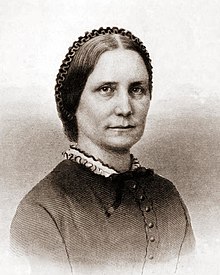
Mar Rice Livermore (from Wikipedia)

Friday, September 23, 2011

A Woman Determined to Follow Her Man

This entry is from My Story of the War by Mary Ashton Rice Livermore. Livermore was a journalist, and an advocate for woman's right.

Here she tells of an incident happening to the 19th Illinois Regiment.  This regiment left Camp Douglas for action on July 12, 1861, so the the episode that Livermore describes here would have happened around that time.

. .. . I remember another occurrence of that afternoon when we visited the camp of the Nineteenth Illinois. I was watching companies that were drilling, a good deal amused at their awkwardness and their slow comprehension of the orders given them. One of the captains came to me, with an apology for intrusion, and begged to know if I noticed anything peculiar in the appearance of one of the men, whom he indicated. It was evident at a glance that the "man" was a young woman in male attire, and I said so. "That is the rumor, and that is my suspicion," was his reply. The seeming soldier was called from the ranks and informed of the suspicions afloat, and asked the truth of them. There was a scene in an instant. Clutching the officer by the arm, and speaking in tones of passionate entreaty, she begged him not to expose her, but to allow her to retain her disguise. Her husband had enlisted in his company, she said, and it would kill her if he marched without her. "Let me go with you!'' I heard her plead. "Oh, sir, let me go with you!" She was quietly conducted outside the camp, when I took her in charge. I wished to take her to my home; but she leaped suddenly from the carriage before we were half way from the camp, and in a moment was lost amid the crowds hastening home from their day's work.

That night she leaped into the Chicago river, but was rescued by a policeman, who took her to the Home of the Friendless. Here I found her, a few days later, when I made an official visit to the institution. She was extremely dejected, and could not be comforted. It was impossible to turn her from her purpose to follow her husband. "I have only my husband in all the world," she said, "and when he enlisted he promised that I should go with him; and that was why I put on his clothes and enlisted in the same regiment. And go with him I will, in spite of everybody."  The regiment was ordered to Cairo, and the poor woman disappeared from the Home the same night. None of us doubted but she left to carry out her purpose.

An Illustration from Mary Livermore's book